IA and link building – Jesús Alfaro
Jesús Alfaro Aguado is a founding partner and CSO of the link building and PR tool LEOlytics, which has extensive experience in the SEO sector and marketing activities. In 2012, he co-founded Into the Marketing Media Group alongside Rocío Martín Travesí.
Two years later, they launched the LEOlytics project, a marketplace that connects webmasters (general media, themed blogs) with companies that want to promote their projects through link building or brand reputation strategies.
After more than 11 years of history, since 2014, the way of doing link building, SEO and branding has been evolving, so we began by asking him about his beginnings and how the platform has adapted to the changes.
When you started out in marketing, did you think you would end up managing teams?
Back then, I came to Berlin on a scholarship while studying tourism in Seville. I had no idea what SEO or digital marketing was, so I learned everything in Germany.
Rocío and I both started working at an SEO agency that served markets such as Spain, Germany, Brazil and France. This opened up new digital horizons for us, as the agency we worked for wanted to compete with Google’s advertising service by creating its own advertising system. They had a portfolio of hundreds of themed blogs where they added ads for fashion, beauty, relationship brands, etc.
Rocío was part of the SEO team responsible for improving the positioning of these blogs, while I initially focused on writing articles and later on contacting potential clients to invest in ad campaigns within the blogs.
During this period, Rocío came up with the brilliant idea of publishing articles in other external media. Not link exchanges, but new publications that linked to the company’s blogs, focusing on generalist news media, which had a very positive effect on the visibility of those domains.
Thanks to all this knowledge within the company, we decided to launch our first blog, femquality.com, where we put everything we had learned into practice and realised that SEO really worked. I remember that we managed to rank with keywords such as ‘Bershka online’. It was amazing.
From there, we created our agency, Into the Marketing Media Group, and later LEOlytics.
How has artificial intelligence changed the way link building is done?
It is still too early to give a definitive answer, but there are many indications that link building and AI will not clash within the same SEO strategy, but rather complement each other.
Based on current knowledge, we are already seeing progress and involvement from companies working through our platform, combining link generation with actions more focused on transmitting information that will be visible through different LLMs.
From our business model, we have always wanted to stay ahead of the curve as much as possible (since the sector moves too fast) with the arrival of this new avenue, the user’s modus operandi in terms of search methodology. That is why, just a few weeks ago, we launched a new article publishing service focused on increasing visibility within ChatGPT, Perplexity and other market players.
AI is here to streamline processes, but not to change the way we search using search engines like Google.
Which tasks do you think can be automated with AI, and which ones still need supervision from an SEO expert?
There are many tasks that can be automated, but none without prior and subsequent review by a person/SEO expert.
We must begin to understand and internalise that AI is a tool to speed up processes, but not an expert player to whom you should sell your soul and trust 100%.
If we look at what it can specifically help with in our daily tasks, what comes to mind is the search for new suppliers to integrate into our portfolio. We are not talking about automating contact, but rather assistance in researching/searching for new domains that meet our requirements.
Can you find good media with the help of AI, or does it take experience to know how to choose well?
As I mentioned in the previous point: yes, you can, and it is very helpful. But of course, it requires knowledge to make a good prompt or generate a suitable path that will lead you to the result you are really looking for.
Does this increase the chances of an LLM recommending the business?
As we mentioned at the beginning of the interview, yes, it does. The aim is to provide an extra channel that the client can incorporate into their strategy, without neglecting link building. Always complement all the possible existing options.
Do you think links will lose their value when more people search using AI browsers instead of Google?
I don’t think so. The ‘link’ factor will continue to be important for many years to come. And it’s important to understand that AI is here to streamline processes, but not to change the way we search using search engines like Google.
We realised that SEO really worked. I remember that we managed to rank with keywords such as ‘Bershka online’. It was amazing.
What are your favourite metrics or methods for determining whether a medium is good for SEO or branding?
Firstly, semantic affinity. It is extremely important that a website that talks about you does so in the most realistic way possible. Users have the right to find/read accurate, well-founded and meaningful news.
The second metric is visits and their origin. When I talk about origin, I mean having media that does not actually buy its visits, generating campaigns to attract visits that only serve to ‘inflate’ the numbers, with visits from countries that have no connection to the market in which the domain is located.
Although I have to say that my favourite metric is human intuition combined with analytics. Let me explain: you have to analyse all possible metrics (DR, Visibility Index, DA, TF, etc.), and not just rely on those numbers, but also think about the intent of our sector. To a certain extent, you have to be guided by tangible/visible examples, as we have seen outrageous things that clash with Google’s guidelines and rank very positively (incomprehensible things).
In your experience, what mistakes do you see clients making when buying links?
Our clients have extensive experience in buying links, from agencies that manage a variety of clients to companies that have their own SEO team, which makes communication with our clients very smooth and pleasant. At LEOlytics, we strive to facilitate the tedious process involved in implementing an SEO strategy. Our clients already have enough with executing their global SEO strategy, communication and other issues to worry about tasks such as contacting and negotiating with webmasters.
Does it help people connect more with the brand?
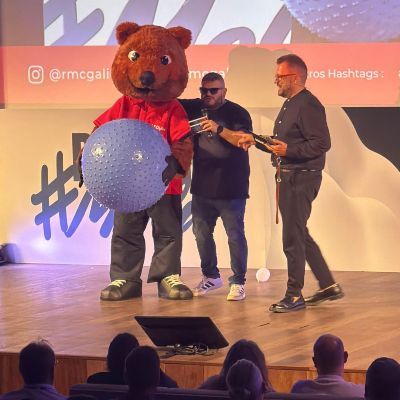
From the beginning, we always wanted to be a friendly, approachable, cheerful and, above all, professional brand. Last year, in 2025, we were able to ‘afford’ to invest time and resources in adopting Linkillo, a combination of ‘Link’ (we know what we’re talking about) and ‘illo’ (a word widely used in Seville).
And a quokka, why? The happiest animal in the world; like us, our philosophy.
And if we can give our Linkillo even more value and authenticity, we pamper it and I try to bring it even more to life by wearing its skin at events where it appears. 😊
What do you think the future holds for ‘courses’ and gurus who teach you how to get customers?
I want to start by answering that question posed by the gurus in the sector, who are not few in number. There are teachers such as Emilio García from Campamento Web or David Ayala from SEORosa, but there is also more and more smoke in the sector, coming from people who have hardly ever touched/worked in a company, and who try to attract ‘novice’ users who think they will become millionaires in a month.
Without losing the thread (I tend to ramble a lot), it is clear that both the dynamics and the way certain information is conveyed are going to change, and if you are not ‘in the loop’, it will be useless.
Paco Garrido is a great friend of the sector and will probably think much the same as I do: there is more and more competition, more ways to transmit information (YouTube, Spotify, iVoox, etc.), and the way people who teach online courses earn money will become increasingly difficult and require more time and resources.
Every guru in the sector will need to know how to tackle this new phase, facing new players on this big stage and all these new channels of dissemination.
That said, and in conclusion, the best way to achieve success in the future will be to implement a clear, transparent strategy for your users. Without trying to take on the world, simply rely on your ability to communicate and, above all, TEACH.
Every guru must understand that they are creating new leaders in the sector. They are teachers of LIFE and PROFESSION.
What would you ask the next person we interview?
I’m not very technical, so I like to focus more on psychology/marketing at in-person events. Accustomed to being the public face of LEOlytics and attending dozens of events annually, how would you project the future of SEO events for the next two years? Events come and go, but what would be your vision for lead generation (whether as a sponsor or not)?